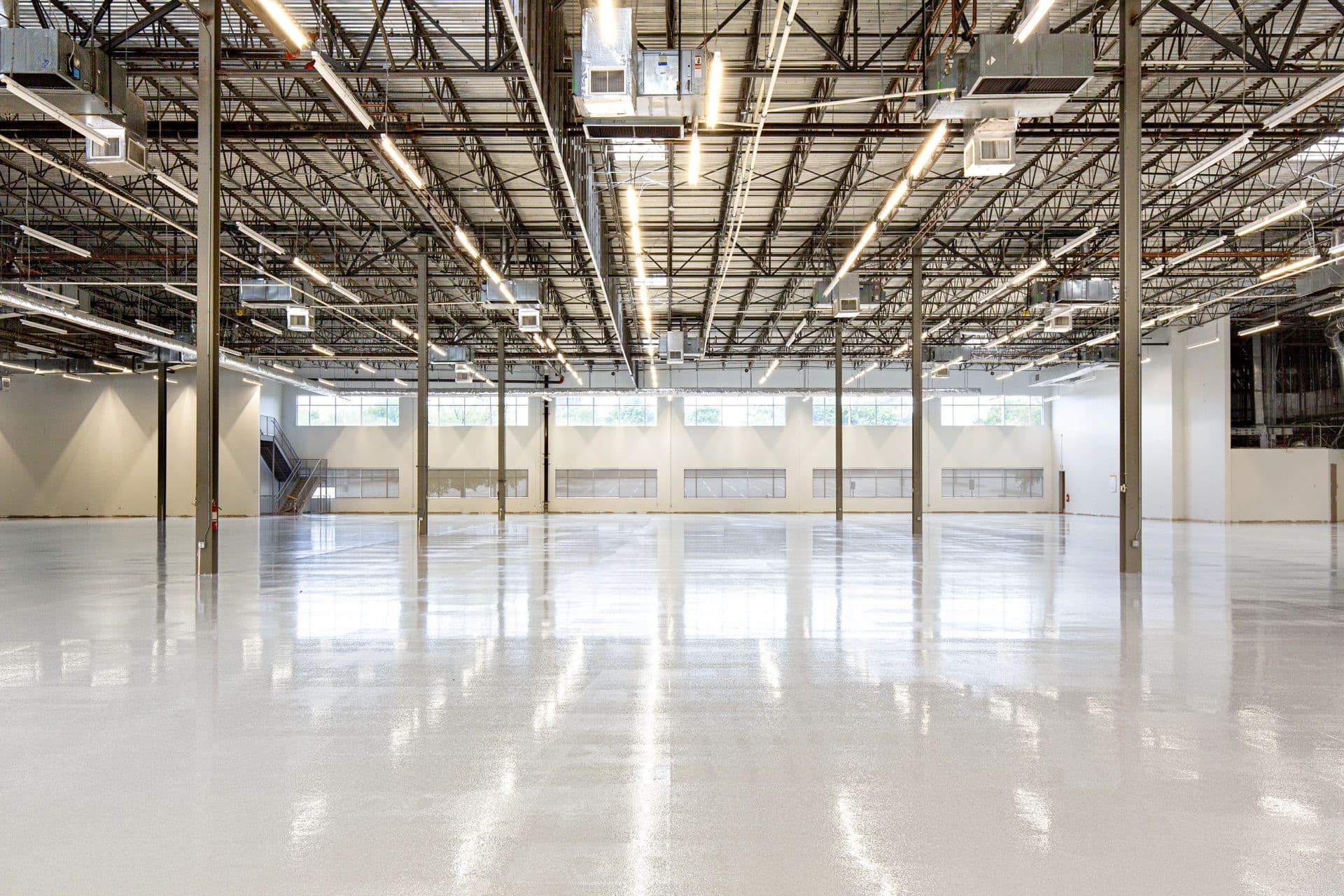
Two very different floors for the same slab
Warehouse and distribution operators in the Lower Mainland routinely ask the same question: should we coat the concrete with epoxy, or grind and polish the concrete itself? Both start with the same slab and both can look excellent, but they solve different problems. The right choice depends on your traffic, your chemicals, and how much downtime you can absorb.
What each system actually is
- Epoxy flooring applies a resin-based coating on top of prepared concrete. It creates a new, seamless surface — colour, texture, and chemical resistance are all engineered into the coating. Related systems include flake broadcast and high-build industrial epoxy and urethane.
- Polished concrete mechanically grinds and refines the existing slab with progressively finer diamonds, then densifies and seals it. There is no coating on top — you are polishing the concrete you already own. See concrete polishing and repair.
Durability and traffic
Both stand up to forklift and pallet-jack traffic when installed correctly, but they fail differently.
- Polished concrete is essentially as durable as the slab itself. There is no coating to peel or delaminate, so it shrugs off heavy point loads and abrasion for decades. Its weakness is impact chipping and staining if the seal is neglected.
- Epoxy offers a tougher, more chemically sealed surface, but it is a coating — and coatings can eventually wear at high-traffic lanes or fail if prep was poor. High-build and urethane topcoats extend life significantly in punishing environments.
For pure abrasion resistance under constant traffic, polished concrete has a slight edge on longevity. For impact and chemical protection, epoxy wins.
Chemical and moisture resistance
This is often the deciding factor.
- Epoxy is the clear winner for chemical exposure. It resists oils, solvents, acids, and cleaning chemicals, and its seamless surface blocks liquids from reaching the concrete. Essential for battery-charging areas, wash bays, and any facility handling fluids.
- Polished concrete is porous by comparison. Densifiers and sealers help, but aggressive chemicals and standing liquids can etch or stain it. Moisture in the slab is not an issue for polishing, whereas high moisture can threaten epoxy adhesion unless mitigated.
Cost comparison
In BC in 2026, installed costs are broadly comparable but the curves differ:
- Polished concrete: roughly $5–$12 per sq ft depending on the level of grind, repair, and gloss.
- Epoxy systems: roughly $5–$16 per sq ft depending on build and chemistry.
The bigger difference is lifecycle cost. Polished concrete has very low maintenance and no recoating, so its cost per year is often lower. Epoxy may need a topcoat refresh in high-traffic zones over its life, but it protects the slab from damage that would be expensive to repair.
Maintenance
- Polished concrete: dust-mop and occasional auto-scrub. Periodic re-polishing or resealing keeps the gloss. Extremely low ongoing cost.
- Epoxy: easy to clean thanks to the seamless surface; sweep, mop, or scrub. Watch high-traffic lanes for wear and refresh the topcoat before the base coat is exposed.
Appearance and safety
- Both can be bright and reflective, which improves light levels and safety in a warehouse.
- Epoxy offers more design flexibility — colours, flake, line-striping integration, and built-in anti-slip texture for wet or ramp areas.
- Polished concrete has a clean, industrial look but limited colour options and can be slippery when wet unless treated.
Downtime and installation
- Polished concrete is often faster and produces no VOC-heavy fumes, so it can be installed with less disruption.
- Epoxy requires cure time between coats, so full systems take several days. Fast-cure polyaspartic hybrids shorten this considerably when downtime is critical. Either way, we schedule evenings, weekends, and phased work to keep your operation moving.
Quick decision guide
Choose polished concrete if:
- Your slab is in good condition
- You want the lowest long-term maintenance
- Chemical exposure is minimal
- You value maximum abrasion life
Choose epoxy if:
- You handle oils, chemicals, or standing liquids
- You need anti-slip or colour-coded zones
- Your slab needs sealing from contamination
- Appearance and brightness are priorities
Can you combine both?
You do not always have to pick one. Many facilities use a hybrid approach: polished concrete in low-risk storage and aisle areas for its unbeatable maintenance cost, and epoxy in wash bays, charging stations, and processing zones where chemicals and liquids demand a sealed surface. Colour-coded epoxy can also mark safety zones, fire lanes, and traffic paths within an otherwise polished floor. Zoning the floor to the actual demands of each area often delivers the best value across the whole facility.
Common mistakes to avoid
Whichever system you choose, the same errors cause most disappointment:
- Skipping moisture testing before an epoxy install
- Under-preparing the slab — both systems live or die on prep
- Choosing on price alone rather than matching the system to traffic and chemistry
- Ignoring joints and cracks, which telegraph through any finish if not addressed
Not sure? Let's assess the slab
Often the slab itself decides for you. Its condition, moisture level, and your operational chemistry all point toward one answer. We offer free on-site assessments across Surrey, Coquitlam, and the Fraser Valley, with moisture testing and a written recommendation.
Call 778-538-1802 or email operations@precisionindustrialpainting.com to book a walkthrough.